
Description
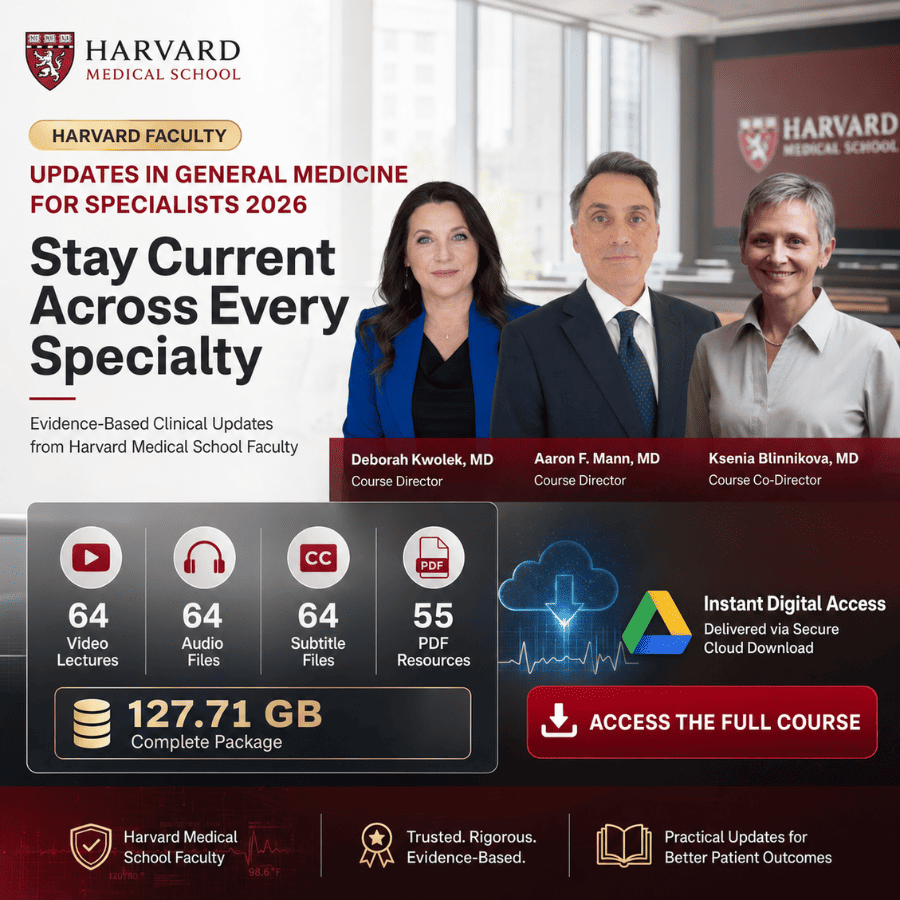
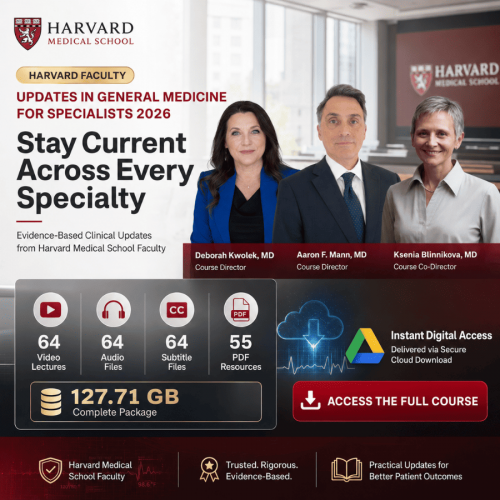
📦 Course Package
🔹 Include: 64 Videos (.mp4) + 64 Audios (.mp3) + 64 Subtitles (.vtt) + 55 PDFs
🔹 Size: 127.71 GB
👨⚕️🧑🏾💻 Target Audience
🔹 Internists
🔹 Subspecialists
🔹 Primary Care Physicians who want updates on internal medicine, chronic disease management, and digital health tools.
📌 Information
1. Overview
The Harvard Updates in General Internal Medicine for Specialists 2026 course provides a comprehensive review of the latest clinical advancements across multiple medical disciplines. Designed for subspecialists, the program explores current evidence-based treatments for cardiovascular disease, endocrine disorders, neurological conditions, infectious diseases, and emerging topics such as AI integration in clinical practice.
📅 Course Date: January 26, – January 30, 2026
General Medicine for Specialists (formerly General Internal Medicine for Specialists) is a one-of-a-kind course designed to provide specialists with the latest, evidence-based updates in general medical care. With expert-led presentations spanning core topics in medicine from over 35 medical specialties, General Medicine for Specialists provides an outstanding opportunity to refresh knowledge in areas beyond core expertise to enhance the general care of patients.
Now in its third decade, the vibrant and well-attended General Medicine for Specialists course serves a broad national and international multispecialty audience and is available as a hybrid with both in-person in Boston, MA—a vibrant hub for medical innovation and a wonderful city to visit—and remote learning options.
The live stream includes real-time closed captioning and multilingual translation, ensuring accessibility for a global audience. The concurrent session options and bonus video library empower participants to tailor their learning experience to the topics which are most relevant and interesting to each specialist in their practice.
Past participants include members of nearly all specialties, with a large number of surgeons, psychiatrists, OB/GYN, and physical medicine and rehab physicians.
⭐ Highlights for 2026
Be empowered to implement new treatment guidelines, diagnostic recommendations, and management strategies for cancer screening, diabetes, hypertension, hypercholesterolemia, ischemic heart disease, heart failure, chronic kidney disease, memory loss, opioid use, sleep disorders, and many other specific conditions, with over 28 lectures, 24 workshops and a bonus library.
🔹 Ischemic heart disease
🔹 Hepatitis
🔹 Stroke
🔹 Chronic obstructive lung disease
🔹 Diabetes management
🔹 Menopause management
🔹 Anticoagulation
🔹 Non-diabetes endocrinology
🔹 Cognitive decline
🔹 Congestive heart failure
🔹 Common eye problems
🔹 Management of GI complaints
🔹 Breast cancer risk
🔹 Basic orthopedics
🔹 Atrial fibrillation
🔹 Lipid management
🔹 Disease prevention and health promotion
🔹 Osteoporosis management
🔹 Asthma
🔹 Renal medicine
🔹 Sleep disorders
🔹 Genetic Testing
🔹 Managing obesity
🔹 Headaches
🔹 Allergy medicine
🔹 Thyroid disorders
🔹 Hypertension
🔹 Lower back pain and more!
🎯 2. Learning Objectives
✅ Apply updated evidence-based guidelines to the diagnosis and management of common medical conditions including cardiovascular disease, diabetes, dyslipidemia, hypertension, chronic kidney and liver disease, sleep disorders and women’s health.
✅ Translate innovative, evidence-based interventions from across specialties into effective clinical practice.
✅ Recognize the management strategies and clinical decision-making of colleagues, including the rationale for specific modalities and medications.
✅ Evaluate the current and future role of Artificial Intelligence in medicine, including its applications in diagnostics, clinical decision-making, risk prediction, and workflow efficiency.
✅ Implement best practices in preventive care, screening, and health promotion, with a focus on older adults and patients with multimorbidity.
✅ Assess the value of new diagnostic and screening tests, including changes to thresholds for established testing.
✅ Anticipate and manage adverse effects of therapies prescribed across specialties.
✅ Manage complex patients by assessing comorbidities and anticipating adverse interactions between therapies prescribed across specialties.
✅ Perform focused examination skills in areas such as basic orthopedics.
✅ Incorporate breakthrough innovations with proven patient benefit into clinical care.
👨⚕️👩🏾⚕️ 3. Target Audience
Best for subspecialists and primary care physicians who want updates on internal medicine, chronic disease management, and digital health tools.
Who Should Participate
🔹 Medical Sub-Specialists
🔹 Surgeons
🔹 Nurse Practitioners
🔹 Physician Assistants
🔹 Physical Medicine and Rehab Specialists
🔹 Psychiatrists
🔹 OB/GYN Clinicians
🔹 Primary Care Physicians
🔹 Residents
🔹 Fellows
🔹 Nurses
🔹 Allied Health Professionals
📚 4. Topics
Day 1
01- Course Introduction
02- Chronic Ischemic Heart Disease Treatment Choices in 2026
03- Women’s Health Hormone Therapy for Treatment and Prevention
04- Updates in Stroke Prevention and Treatment
05- Frequently Asked Questions in Hematology: A Case-Based Approach
06- A1 Healthcare Delivery in the Face of Climate
07- A2 Insomnia Treatment
08- B1 Opioid Use Disorder
09- B2 Lyme and Tick-borne Diseases
10- C1 Shoulder, Elbow, Wrist, Hand Pain Diagnosis and Management
11- C2 Update in Renal Medicine
12- D1 Diseases of the Foregut Updates from the Upper GI Tract
13- D2 Ophthalmology in Primary Care
14- Using Alto Optimize the EHR Experience for Clinicians
15- Diabetes: An Update for Subspecialists
16- Update on Anticoagulants and Venous Thromboembolism
17- Hyperlipidemia 2026
18- E1 Autonomic Medicine
19- E2 The Digital Healthcare Landscape 2026
20- F1 Asthma Updates
21- F2 Anxiety and Depression
22- G1 Lung Cancer Screening and Strategic Approach to the Management of Pulmonary Nodules
23- G2 New and Emerging Viruses
24- H1 Pre and Post-Exposure Prophylaxis for HIV and STIs
25- H2 Neuropathy: What You Need to Know
26- AI in Medicine Promises and Pitfalls
27- Common Outpatient Infections: Current Treatment Recommendations
28- Updates in Addressing Headaches
29- Atrial Fibrillation
30- I1 Genetic Testing for Cancer Risk
31- I2 Managing Obesity
32- J1 Prostate Cancer- Screening and Beyond: Disparities, Therapy, Medical Malpractice Avoidance and Advances
33- J2 Intermittent Fasting and Circadian Rhythms: Does When You Eat Matter
34- K1 Chronic Obstructive Pulmonary Disease
35- K2 Review & Updates in Hypertension Management
36- L1 New Practices for Managing Osteoporosis and Reducing Fractures
37- L2 Tuberculosis 2026
38- Memory Loss, Alzheimer’s Disease, and Dementia Update 2026
39- Infectious and Metabolic Liver Disease
40- 2026 Heart Failure Update for Subspecialists
41- Treating Tobacco Use Optimizing forEnduring Outcomes
42- Breast Cancer Current Approaches to Prevention, Diagnosis and Treatment
43- Introduction to Lifestyle Medicine
44- Updates in Allergy Whatto Know in 2026
45 Mood Disorders in Geriatrics
46- Putting Evidence Into Practice Lessons from Implementation Research
47- Common Thyroid Problems
48- Principles of Care for the Older
49- Lower Back Pain Evaluation and Treatment Approaches
50- Case Studies in Reproductive Endocrinology
51- Teaching in the 21st Century: Leveraging the Science of Learning
52- Special Lectures A- New and Emerging Viruses – Martin Hirsch
53- Special Lectures B- Supplements – Pieter Cohen
54- Special Lectures C- Hormone Therapy for Women- Clinical Cases – Dr. Deborah Gomez Kwolek
55- Special Lectures D- Practical Tips to Address Health Insurance Challenges – Lori Tishler
56- Special Lectures E- Practicing with Health Equity in Mind – Aisha James

5 reviews for Harvard Updates in General Internal Medicine for Specialists 2026
There are no reviews yet.