

Description
About This Course
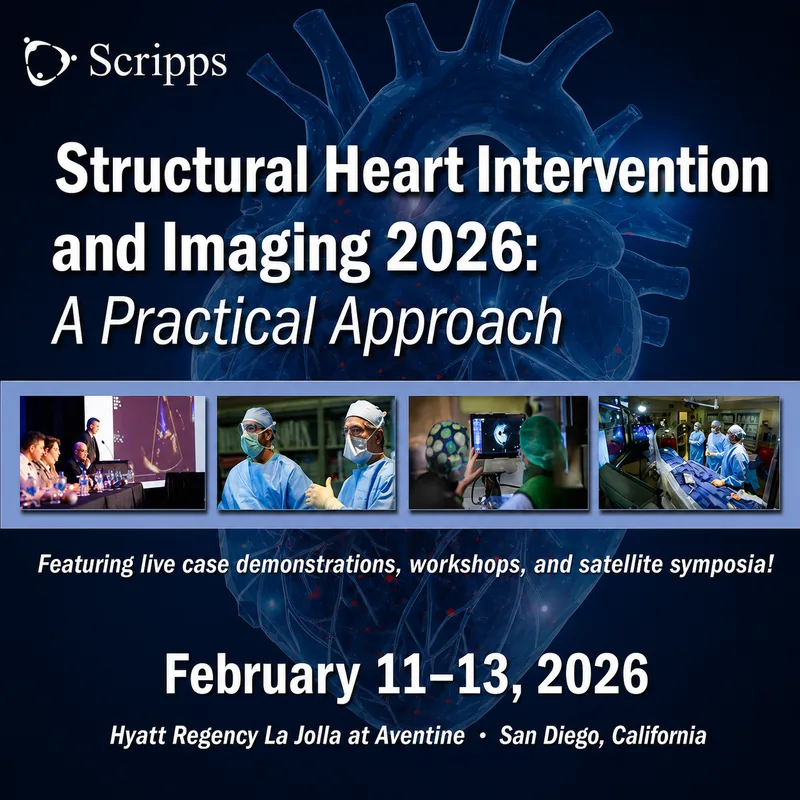
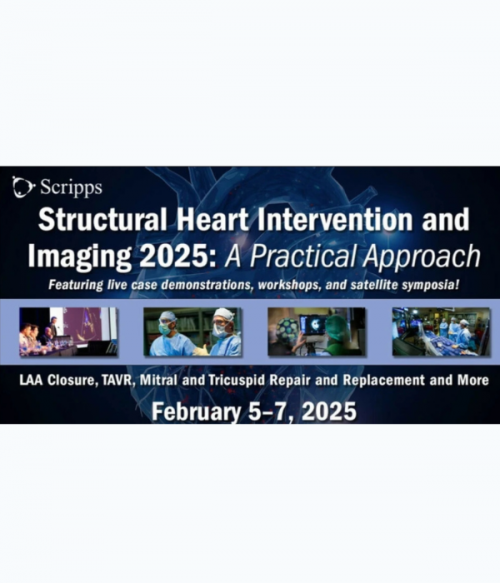
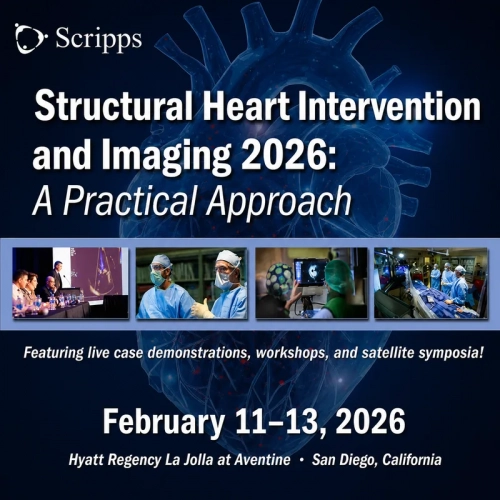
Scripps 15th Annual Structural Heart Intervention and Imaging 2026 is an advanced structural heart disease course focused on contemporary transcatheter therapies, procedural imaging, patient selection, live case learning, and complex case management. The program provides a practical, state-of-the-art review of interventions such as TEER, TAVR, TMVR, TTVR, LAAO, and PFO closure.
This course is designed for interventional cardiologists, echocardiographers, and cardiac surgeons who want deeper clinical training in structural heart interventions and advanced cardiovascular imaging. It emphasizes multidisciplinary collaboration, procedural planning, imaging integration, complication prevention, and future innovations in structural heart care.
The 2026 program includes expert-led lectures, live case demonstrations from Scripps Clinic, advanced 3D ICE and TEE guidance, CT and MRI assessment, stroke prevention strategies, and practical approaches to improving procedural safety and patient outcomes.
Why Choose This Course
- Focused coverage of advanced structural heart interventions including TAVR, TEER, TMVR, TTVR, LAAO, and PFO closure.
- Practical imaging education using TTE, TEE, 3D ICE, CT, and MRI for procedural planning and guidance.
- Includes live case-based learning from Scripps Clinic for real-world procedural decision-making.
- Covers current patient selection strategies, device planning, complication prevention, and outcomes assessment.
- Designed for busy clinicians who need flexible recorded access to advanced specialty education.
- Strong emphasis on multidisciplinary structural heart team collaboration and procedural safety.
- Includes downloadable video lectures, subtitles, and PDF materials for ongoing reference.
Learning Objectives
Structural Heart Team Optimization
Build and optimize a multidisciplinary team to improve management of patients with structural heart disease.
Advanced Imaging Selection
Identify the equipment and imaging technologies needed for safe and effective structural heart interventions.
Valve & Chamber Assessment
Apply echocardiography, ICE, CT, and MRI to assess the aortic, mitral, and tricuspid valves and cardiac chambers.
Current Procedure Indications
Outline indications for LAA closure, PFO closure, TAVR, TMVR, mitral TEER, tricuspid TEER, and TTVR.
LAAO Evaluation
Evaluate imaging before and after LAA closure and identify leaks, thrombus, device position, and complications.
TEER & TMVR Strategy
Select treatment strategies for mitral and tricuspid valve disease based on imaging findings and clinical context.
Complication Prevention
Recognize LVOTO and coronary obstruction risks and apply prevention strategies such as LAMPOON and BASILICA.
Procedural Safety
Employ best practices to manage potential complications of catheter-based structural heart therapies.
Course Curriculum & Learning Modules
01. TEER Procedural Strategy & Imaging Foundations
- 01 San Diego Transcatheter Edge-to-Edge Repair Conclave
- 02 Best Practices for T-TEER Procedural Strategy
- 03 Getting off the Struggle Bus During TEE Imaging: How to Acquire the Key Views When Imaging is Challenging
- 04 M-TEER Beyond A2-P2: Key Techniques to Address Near-Commissural Jets
- 05 Invited T-TEER Case Presentation from San Diego Operator Imaging Team, with Panel Discussion — Arvin Narula, MD
- 06 Invited T-TEER Case Presentation from San Diego Operator Imaging Team, with Panel Discussion — Ryan Reeves, MD
- 07 New Frontiers in MR and TR Treatment: PASCAL Precision System Predictability and the Era of EVOQUE TTVR — Amr Mohsen, MD
- 08 LIVE CASE FROM SCRIPPS CLINIC
02. Left Atrial Appendage Occlusion & Stroke Prevention
- 09 Clinical-Pathological Correlations: The Left Atrial Appendage
- 10 TEE vs. 3D ICE for LAAO Procedural Guidance: Strengths, Weaknesses, and How to Choose
- 11 Interpreting CT Imaging After LAAO: Leaks, HALT, DRT, and Device Position
- 12 LAAO Is Safe Until It’s Not: Untoward Events During and After the Procedure and How to Prevent Them
- 13 Managing Peri-Device Leak: Who to Treat and Technically How to Do It
- 14 LIVE CASE FROM SCRIPPS CLINIC
- 20 CHAMPIONing Watchman FLX as a Front-line Treatment Option for AF Stroke Prevention
- 21 What’s the Optimal Post-Procedure Medication Regiment after Watchman FLX PRO
- 22 Addressing Unmet Needs in LAAC with Watchman Next Generation
03. Right Ventricle, Tricuspid Disease & RV Function
- 15 Clinical-Pathological Correlations: The Right Ventricle
- 16 Current State-of-the-Art to Assess Right Ventricular Function by TTE, CT, and MRI
- 17 Managing RV Function Before and After Tricuspid Intervention
- 18 Atrial Functional MR: Identification, Mechanism of Action, and Potential Treatments
- 19 Lead-ing into Trouble: How to Identify Lead-Tricuspid Leaflet Interaction
- 23 LIVE CASE FROM SCRIPPS CLINIC
04. Mitral Valve Intervention, TMVR & Transseptal Imaging
- 24 Clinical-Pathological Correlations: The Mitral Valve
- 25 Cutting Edge Assessment of Mitral Regurgitation in 2026: Quantification, Mechanism, and Localization of Pathology
- 26 Mitral TEER for Moderate MR: Current Data and Future Directions
- 27 Deep Dive and Clinical Implications of the ENCIRCLE Trial: Patient Selection and Technique for Balloon-Expandable-in-Dock TMVR
- 28 Advanced Techniques to Prevent LVOTO After Mitral Valve-in-Valve Implantation
- 29 LIVE CASE FROM SCRIPPS CLINIC
- 30 Concomitant LAA Closure and Mitral TEER: Current Evidence and Procedural Considerations
- 31 Interatrial Shunts for HFpEF and HFrEF: Device and Data Update
- 32 Imaging for Transseptal Puncture to Optimize Safety and Procedural Success
05. Aortic Insufficiency, Amulet & Emerging Aortic Technologies
- 33 Aortic Insufficiency Imaging Evaluation and Indications for Intervention
- 34 Dedicated TAVI for Aortic Insufficiency Has Arrived: Patient Selection, Technology, and Procedural Technique
- 35 Contemporary Outcomes Data with Amulet and the Next Big Randomized Trial: A CATALYST for Change
- 36 Next-Generation Device, Next Generation Results: Amulet 360 and the VERITAS Study
- 37 Optimizing Procedural Outcomes and Safety: Case Examples of Amulet LAAO
- 38 Current State-of-the-art and Unmet Clinical Needs for the Treatment of Aortic Regurgitation
- 39 Imaging for Aortic Regurgitation: From Diagnosis to Patient Selection
- 40 Transcatheter Intervention for Aortic Regurgitation: Emerging Technologies, Clinical Trial Data, and Case Examples
- 41 LIVE CASE FROM SCRIPPS CLINIC
06. Tricuspid Valve Assessment, T-TEER & TTVR
- 42 Clinical-Pathological Correlations: The Tricuspid Valve
- 43 Cutting Edge Assessment of the Tricuspid Valve by Echo Imaging Part I: TR Quantification and Mechanisms of Action
- 44 Tricuspid Surgery for TR: Technique, Outcomes, and Lessons Learned for the Transcatheter Experience
- 45 Cutting Edge Assessment of the Tricuspid Valve by Echo Imaging Part II: Screening for T-TEER and TTVR
- 48 Optimizing T-TEER Outcomes: How to Identify the Right and Wrong Patient
- 49 Insertion, Insertion, Insertion: Imaging Strategies to Confirm Leaflet Grasping During T-TEER
- 50 Optimizing TTVR Outcomes: How to Identify the Right and Wrong Patient
- 51 Hands Off the Valve! The Role of Caval Valve Implantation in Severe TR
- 52 Keys to Enhance Procedural Safety During TTVR
07. 3D ICE, Verisight Pro & Advanced Procedural Guidance
- 53 The Value Proposition for Verisight Pro 3D ICE: Synergizing Hospital, Patient, and Operator Needs
- 54 Getting off the Struggle Bus: Verisight Pro 3D ICE for Tricuspid Transcatheter Edge-to-Edge Repair
- 55 Verisight Pro 3D ICE Guided LAAO Under Conscious Sedation: The Present and Future for Stroke Prevention in AF Patients
- 56 Stop Spinning to Nowhere: Using Verisight Pro 3D ICE for Evoque TTVR
- 57 LIVE CASE FROM SCRIPPS CLINIC
08. TAVR, Coronary Protection & Lifetime TAVI Planning
- 46 Cerebral Protection for TAVR in 2026: How to Apply the Latest Data to Your Practice
- 47 LIVE CASE FROM SCRIPPS CLINIC
- 58 Clinical-Pathological Correlations: The Aortic Valve
- 59 TAVR in 2026: Where Are We and Where Are We Going
- 60 Procedural Planning for Lifetime TAVI Management and Lessons from Past Mistakes
- 61 Leaflet Modification to Prevent Coronary Obstruction After TAVR: Patient Selection and Technical Approach
- 62 Contemporary TAVR for Bicuspid Aortic Valves
Who Should Take This Course
This course is best suited for interventional cardiologists, echocardiographers, cardiac surgeons, structural heart specialists, cardiovascular imaging physicians, electrophysiologists, cardiac anesthesiologists, cardiology fellows, sonographers, and clinicians involved in the evaluation and treatment of structural heart disease.
Delivery & Access
Course Materials
Includes 62 video lectures, 62 subtitle files, and 51 PDF resources. Total package size: 30.98 GB.
Instant Access
Access is provided after purchase so you can start watching the recorded course materials without waiting for shipping.
Lifetime Access
One-time purchase with ongoing access to the included videos, subtitles, and PDF materials for future review.
All Devices
Study on your phone, tablet, laptop, or desktop using a compatible media player and PDF reader.
Reviews
“Excellent structural heart content with very practical imaging guidance. The TEE and ICE discussions are especially useful for procedural planning.”
Interventional Cardiologist“The course gives a strong overview of TEER, TAVR, LAAO, and tricuspid intervention with helpful case-based teaching.”
Echocardiographer“A valuable review for anyone working with complex valve disease and multidisciplinary structural heart procedures.”
Cardiac SurgeonFAQ
Is this course recorded?
Yes. This package includes recorded video lectures for on-demand learning.
What materials are included?
The package includes 62 videos, 62 subtitle files, and 51 PDF resources. Total size: 30.98 GB.
When will I get access?
Access is provided after purchase. You can contact support if you need help with delivery or access.
Can I watch on any device?
Yes. You can access the materials on a phone, tablet, laptop, or desktop using compatible video and PDF software.
Is a sample video available?
Yes. Contact us to request a sample video before purchase.
Who can I contact for help?
You can contact support for help with access, sample video requests, or course material questions.




Very clinically relevant