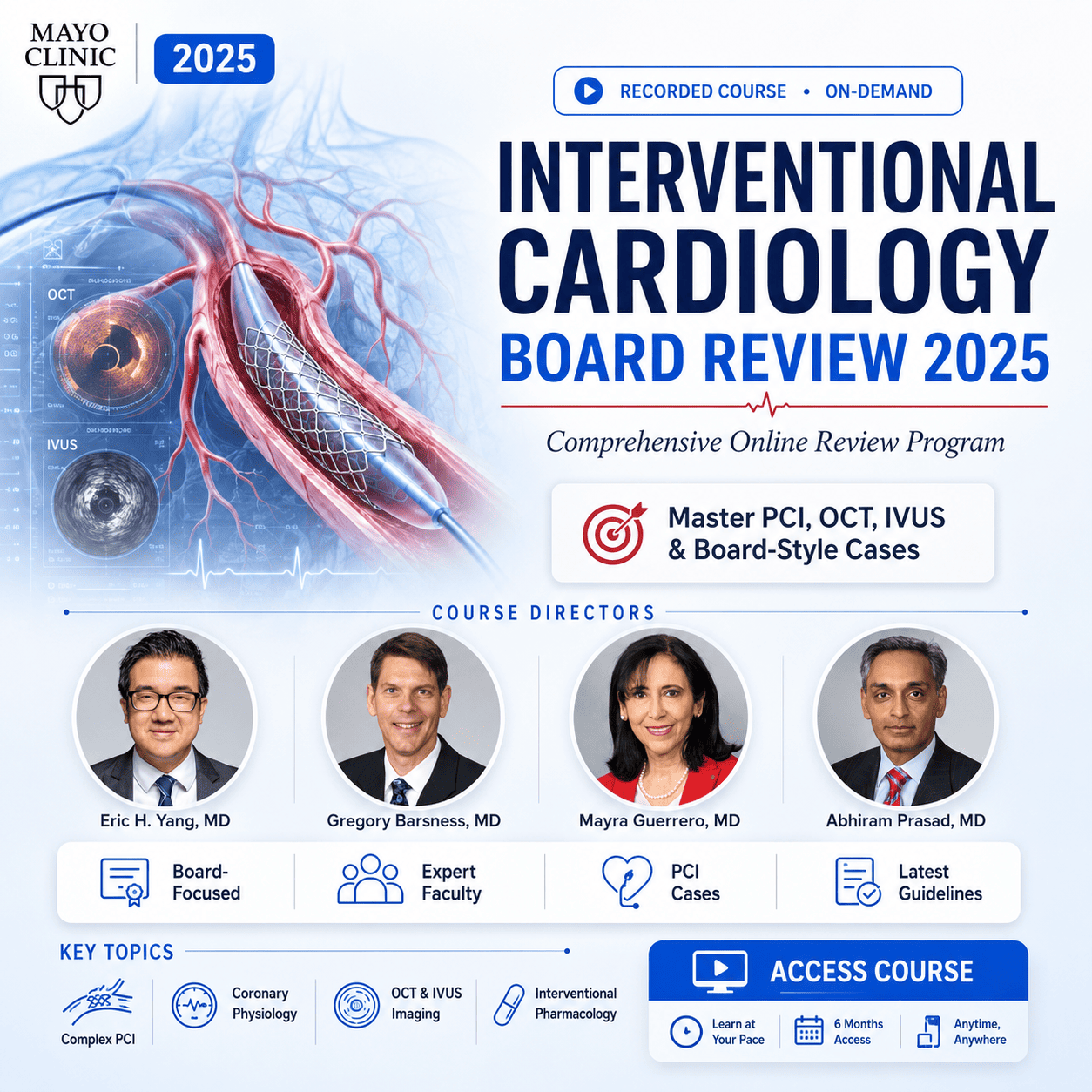
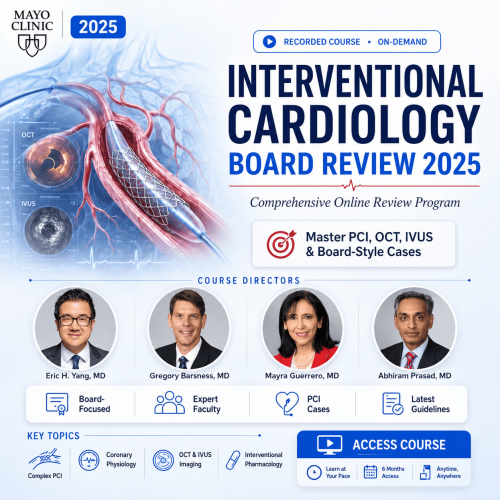
MAYO CLINIC • BOARD REVIEW • 2025 EDITION
Pass Your Interventional Cardiology Boards With Mayo-Level Preparation.
A comprehensive, board-focused review built around the topics interventional cardiologists and fellows actually need:
PCI, OCT/IVUS, FFR/iFR, ACS, TAVR, structural interventions, antiplatelet therapy, cardiogenic shock, PAD, cath-lab fundamentals, and complication management.
39 Video Lectures 39 VTT Subtitles 63 PDF Resources 6.47 GB Release Date: Dec 12, 2025
Best for: Interventional Cardiologists • Cardiovascular Fellows • General Cardiologists • Structural Heart Trainees
Format
Board Review Course
Content
39 Videos + 63 PDFs
Core Topics
PCI • FFR/iFR • TAVR
Access
Digital Google Drive Delivery
WHY THIS COURSE HELPS Board preparation shouldn’t feel like guesswork.
Instead of piecing together scattered notes, random cases, and fragmented review material, this course gives you a structured path through the major domains of interventional cardiology.
✗ Scattered board review
Jumping between unrelated resources makes it harder to build a complete review plan.
✗ Important topics missed
Coronary physiology, access complications, structural interventions, and pharmacology all need focused coverage.
✗ Not built for specialists
General cardiology updates often do not go deep enough for interventional practice or board prep.
✗ Hard to review efficiently
Without an organized curriculum, it’s easy to spend time on the wrong material.
OUR SOLUTION
A structured curriculum that follows what interventional cardiology boards and real-world practice actually demand.
You get comprehensive coverage of PCI, coronary physiology, OCT/IVUS, antithrombotic therapy, ACS, structural heart disease, noncoronary intervention, and complication management—organized in one place for efficient review.
VALUE HIGHLIGHT A complete board-review package in one place.
Built for serious review and easier navigation, with lecture videos, VTT subtitles, and PDF resources ready for structured study.
WHAT YOU RECEIVE
Everything needed for a focused interventional cardiology review.
• 39 topic-based video lectures
• 39 VTT subtitle files for accessible review
• 63 PDF resources and supporting materials
• Coverage from coronary basics to advanced structural interventions
• Organized content suitable for repeat review before boards or recertification
Package Snapshot
39 / 39 / 63
Videos / VTT / PDFs
Digital Delivery Via Google Drive
Best for board preparation, recertification review, and advanced clinical reference.
BOARD-FOCUSED DESIGN Built around what interventional boards actually test.
The curriculum is not just a general cardiology update—it is strongly oriented to the procedural, pharmacologic, physiologic, and structural concepts most relevant to interventional cardiology review.
Coronary PhysiologyReview CFR, FFR, and iFR with practical lesion assessment concepts.
Intracoronary ImagingOCT, IVUS, plaque characterization, and imaging guidance for PCI.
ACS ManagementSTEMI reperfusion, NSTE-ACS invasive strategies, and decision-making.
Complex PCICTO, left main, bifurcation disease, SVGs, restenosis, and access-related issues.
Structural HeartTAVR, Mitral Clip, tricuspid interventions, LAA closure, ASD/PFO/VSD management.
Pharmacology & BleedingAntiplatelets, anticoagulation, triple therapy, dual therapy, and bleeding risk.
PAD & Vascular DiseasePeripheral arterial disease, carotid interventions, venous intervention, and stroke topics.
Cath-Lab FundamentalsRadiation safety, device selection, appropriateness, performance metrics, and hemodynamics.
About This Course
Mayo Clinic Interventional Cardiology Online Board Review 2025 is a specialist-level educational program developed for cardiologists and cardiovascular fellows who need a structured review of contemporary interventional cardiology. The course covers the essential clinical and procedural knowledge base required for certification, recertification, and focused advanced review.
The program spans foundational topics such as catheterization laboratory equipment, radiation physics and safety, pharmacology, and procedural planning, then progresses into high-value interventional subjects such as OCT, IVUS, FFR, iFR, CTO, left main and bifurcation disease, TAVR, mitral and tricuspid interventions, LAA closure, cardiogenic shock, PAD, and PCI complications.
Compared with broad cardiology updates, this course is more targeted, more board-oriented, and more relevant to physicians who need dedicated interventional cardiology review.
Learning Objectives
Upon Completion, Learners Should Be Able To
✓ Describe bleeding risk with triple therapy after PCI
✓ Review current data regarding dual therapy combinations
✓ Review the use of OCT and IVUS in assisting with PCI and plaque assessment
✓ Describe coronary physiology and review the principles of CFR, FFR, and iFR
✓ Determine reperfusion strategy for STEMI patients who present to facilities without PCI capability
✓ Review current evidence for invasive management of Non-STE-ACS patients
✓ Identify the selection criteria and outcome data for Mitral Clip
✓ Distinguish the indications, complications, and long-term outcomes of TAVR
✓ Review diagnosis and management of peripheral arterial disease
FULL CURRICULUM Every domain the boards use—covered in depth.
To keep the page easy to read and more conversion-friendly, the 39 sessions are grouped below into practical review blocks.
Anatomy & Congenital (2)
Basic Science (2)
Imaging & Physiology (3)
ACS & Case Management (7)
Structural & Noncoronary (8)
Pharmacology (5)
Procedural Techniques (6)
Supplemental Board Review (6)
Section 1 — Anatomy & Anatomic Pathology
Coronary anomalies; Percutaneous management of ASD, PFO, and VSD.
Section 2 — Basic Science & Coronary Syndromes
Anticoagulation and triple therapy; Pathophysiology of chronic and acute coronary syndromes.
Section 3 — Cardiac Imaging & Assessment
OCT, IVUS, plaque characterization, radiation physics, risks, safety, FFR and iFR.
Section 4 — Case Selection & Management
PAD, NSTE-ACS, Mitral Valve Interventions, Quality Metrics, Structural Complications, STEMI reperfusion, CTO.
Section 5 — Catheter-Based Management of Noncoronary Disease
Carotid interventions, septal ablation, TAVR.
Section 6 — Complications of Coronary Intervention
Management of PCI complications.
Section 7 — Miscellaneous
Device selection; Management of cardiogenic shock.
Section 8 — Pharmacology
Antiplatelet therapy, bleeding risks, core board drugs, LAA closure.
Section 9 — Procedural Techniques
Athero-ablative techniques, restenosis, stent thrombosis, tricuspid interventions, SVGs, vascular access, left main and bifurcation disease.
Section 10 — Supplemental Material
Peripheral venous intervention, medical statistics, acute stroke intervention, pulmonic valve/coarctation, PAD, cardiac arrest, hemodynamics, ventricular function.
Want the full session-by-session breakdown? Use the Open Program PDF button above for the attached program document. Note: the linked PDF filename references “Echo Curriculum,” so if you intended a dedicated interventional-cardiology PDF, you may want to replace that link with the correct program file later.
EXPERT-LED REVIEW Learn with Mayo faculty and specialists across the field.
The curriculum is taught by recognized experts covering the exact subjects they practice and teach—from PCI physiology and imaging to structural heart intervention and complex vascular topics.
This makes the course especially valuable for clinicians who want content that is both board-relevant and grounded in real procedural decision-making.
WHAT’S INSIDE
Everything included in your package.
39 Recorded LecturesTopic-based sessions for systematic review.
39 Subtitle FilesVTT files for accessibility and easier review.
63 PDF ResourcesSupporting materials and lecture documents.
Board-Focused TopicsNot generic updates—specialist review content.
Structured Content FlowFrom basics and physiology to advanced procedures.
Great for Repeat ReviewUseful before boards or for selective topic refresh.
Digital DeliveryDelivered via Google Drive with direct access.
Advanced Clinical ReferenceHelpful for fellows and practicing specialists alike.
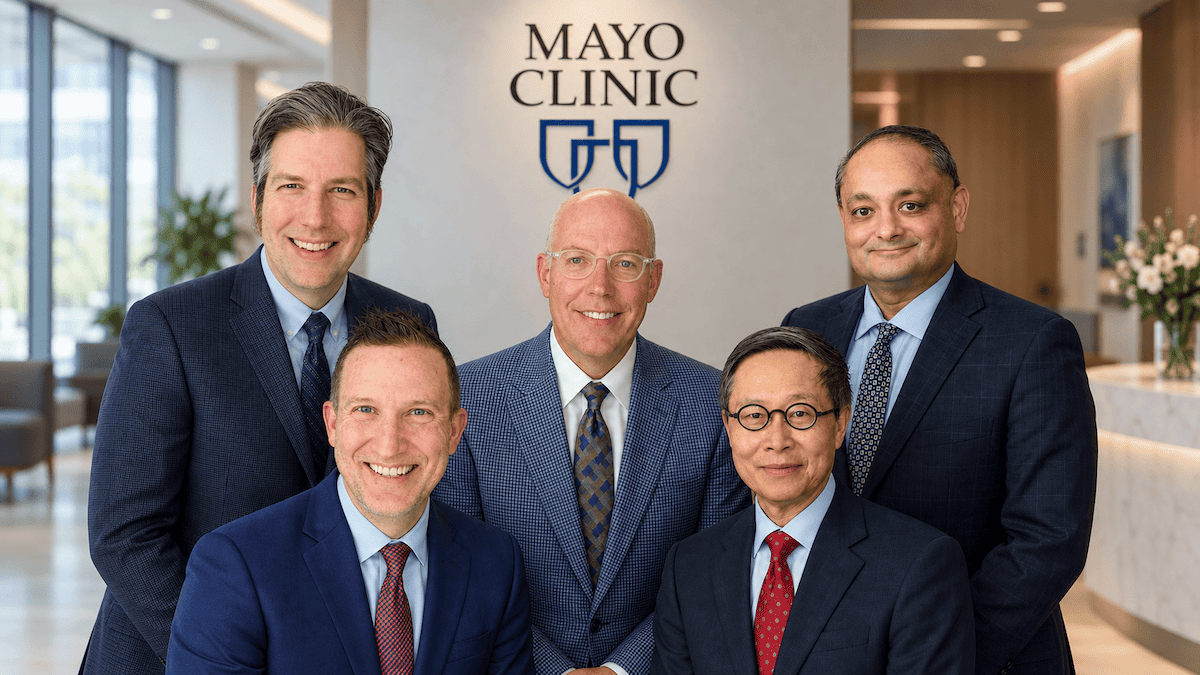
FACULTY Led by Mayo Clinic cardiologists and faculty.
This course is guided by experienced faculty who teach high-yield interventional topics with a strong balance of board review and practical clinical application.
Gregory W. Barsness, M.D.
Mayra Guerrero, M.D.
Abhiram Prasad, M.D.
Eric H. Yang, M.D.
Rajiv Gulati, M.D., Ph.D.
Mandeep Singh, M.D.
Who Should Take This Course
This course is primarily intended for cardiologists and cardiovascular fellows preparing for the ABIM Interventional Cardiology certification or recertification exam.
It is also useful for: Interventional cardiologists • General cardiologists • Invasive cardiologists • Structural heart trainees • Advanced cardiovascular practitioners seeking a focused review of contemporary interventional cardiology.
★★★★★
“A well-organized way to review the interventional topics that matter most—especially helpful before boards and for refreshing high-yield procedural concepts.”
Typical value statement used for educational product presentation
READY TO REVIEW? Don’t wait until the boards are near.
Use a structured, specialist-level review to revisit PCI, structural heart disease, coronary physiology, pharmacology, and the high-yield concepts tested most often.
Review Course Content Common Questions
Is this a general cardiology course?
No. It is a focused interventional cardiology board-review style course.
What is included in the package?
39 video lectures, 39 VTT subtitle files, and 63 PDF resources, totaling about 6.47 GB.
Who is this most useful for?
Best for interventional cardiologists, cardiovascular fellows, and cardiologists seeking advanced interventional review.
How is it delivered?
Digital delivery through Google Drive access.
Does this include official CME or Mayo enrollment?
No. This listing is for digital educational course materials only and does not include official enrollment, CME/MOC credit, or certification.
Important Notice
This listing is for digital educational course materials only. It does not include official Mayo Clinic enrollment, access to Mayo’s personalized learning portal, CME credit, ABIM MOC credit, certification, exam registration, or any guarantee of procedural competence. Attendance at the original Mayo course does not by itself establish competence or proficiency in procedures discussed.





Reviews
There are no reviews yet.